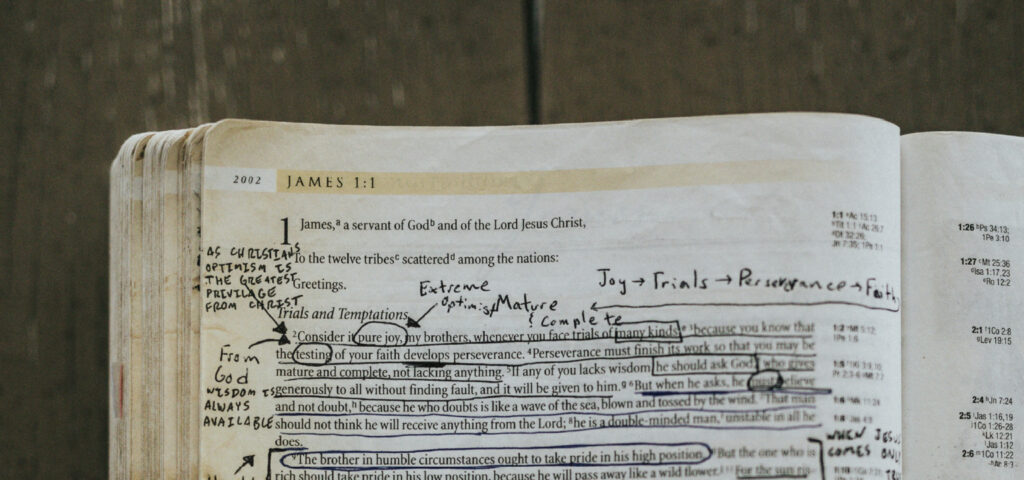
I love picking one book in the Bible and reading it over and over again, taking time to get to know it. Some days it feels tedious, but it does something to solidify those truths in my mind. Also, it somehow even becomes friendly. When I go back to some of the books I’ve spent a lot of time reading and re-reading, I feel like I’m visiting with an old friend. If someone references a verse from one of those books, I not only remember what I was doing but also where I was when I was reading that book. Again and again.
Lately, I’ve been reading and re-reading Colossians in my quiet times. I’ve also listened to it on my way to work. It’s short, only four chapters. But it’s crammed with practical theological truths that are easy to say but take a lifetime to learn. Truths like, “Wives, submit to your husbands, as is fitting in the Lord. Husbands, love your wives, and do not be harsh with them. Children, obey your parents in everything, for this pleases the Lord. Fathers, do not provoke your children, lest they become discouraged.” Colossians 3:18–21 (ESV)
Over Time
Paul’s letter to Colossae is also bursting at the seams with bold doctrinal claims that have shaped the Christian church. Equally important, they have kept her from falling into error, or even full-blown heresy, over the past two thousand years. For example, in the fourth century, Arians used the words “firstborn of all creation” to argue that Jesus was a created being. Athanasius called out the error of the Arians, using the rest of Colossians (and other parts of Scripture). Thankfully, the bishops at Nicaea formally condemned this heresy in 325. Since then, the Church has affirmed that Jesus is “…very God of very God; begotten, not made; being of one substance with the Father…” as the Nicene Creed claims. This is a closed-handed, non-negotiable doctrine for Christians. As of late, I’ve been able to reinforce that truth (and many others) every day for about a month now!
Sadly, some people have also taken a few verses in Colossians out of context. They have misused and abused them to condone slavery. Thankfully, Christian abolitionists interpreted Scripture with Scripture to ultimately condemn slavery. This study has prompted me to ask questions and dig deeper into what Paul meant when he wrote it. If you’re curious about this, we will study and clarify what he meant in these verses when we resume our study of Colossians at church.
Make An Old Friend
Having a hard time deciding what to read in your Bible? I invite you to join me in reading Colossians every day (until the end of our study in early December). Make it an old friend. Enjoy it, obey it, learn it, and grow. Along with that, ask questions, listen to sermons, and read commentaries. Pray that God’s Spirit will use His Word to help you know Him better, glorify Him first, and enjoy Him forever.
I always enjoy meeting new visitors at The Rock and asking them questions about their lives. Seems like everyone has a story. And it can be kind of like spiritual “mining” when I’m trying to learn more about them. I look for evidence of Jesus in their lives, like a miner digging for gold. Sometimes, I find it near the surface. Perhaps these visitors are hurting and can’t help but pour out their emotions. Other times, I definitely need more effort and patience to be a good listener and befriend them.
And when that happens, if I am honest, I don’t always want to put in the effort. But here’s the thing. I’m usually the one missing out when I choose not to listen to someone’s story. I particularly enjoy salvation stories. Here is one of my favorites.
“But this is what the LORD says: I would no more reject my people than I would change my laws that govern night and day, earth and sky.” — Jeremiah 33:25–26 (NLT, excerpt)
I recently visited a church in Phoenix, Arizona, with my son. Time to tour colleges and explore some options for his future education. We then decided to attend a local church on Sunday morning.
A few things stood out to me during our visit that were incredibly meaningful.
“For the time is coming when people will not endure sound teaching, but having itching ears they will accumulate for themselves teachers to suit their own passions, and will turn away from listening to the truth and wander off into myths.” — 2 Timothy 4:3–4
We live in a remarkable age! With my phone, I can listen to or watch podcasts, videos, reels, and music from around the world. Individual results may vary, but studies find people spend:
In 1952, Florence Chadwick attempted something almost unimaginable: swimming the 22.8 miles from Catalina Island to the California mainland.
Florence definitely knew a thing or two about long swims. She had already become the first woman to swim the English Channel in both directions. But that day, off the California coast, the water was freezing. Also, people in the support boats had to drive sharks away, and a thick fog settled over the ocean.
Comments Off on Does Following Jesus Make You Stand Out?
“And you will be my witnesses, telling people about me everywhere…” — Acts 1:8 (NLT)
Being a witness isn’t always easy or comfortable. At times, standing out for Jesus might mean looking like the weirdo or the outcast. It can also feel like cultural suicide or even career suicide.
But you know what? We should look different from the world around us. In fact, we should stand out. Jesus certainly did. His followers did, too.
Sadly, I think this is one of the more dangerous things that has crept into Western Christianity at large. This desire to look just like the world. To not rock the boat or let others label us as extreme or different.
“And have put on the new self, which is being renewed in knowledge after the image of its creator.” — Colossians 3:10
There is something incredibly encouraging hidden in that little phrase, “being renewed.” God’s Word reassures you that God, not you, makes you new. Paul doesn’t say, “You just need to do better.” or “Try harder to become a better version of yourself.” The wonderful thing about this verse is that for all who belong to Christ, God is already doing something in you.
“Sensible people keep their eyes glued on wisdom, but a fool’s eyes wander to the ends of the earth.” — Proverbs 17:24 (NLT)
Notice that Solomon doesn’t separate the wise from the foolish by intelligence in this verse. Instead, he points out that it’s connected to where they’re looking. The fool isn’t necessarily ignorant. He’s distracted. His eyes roam to the ends of the earth, always scanning for the next thing. A fool wants the far-off answer, the life he assumes is happening elsewhere. He always thinks the grass is greener somewhere else. The wise person, by contrast, doesn’t have to search to the ends of the earth. Why? Because wisdom isn’t far away. Moses told Israel that God’s word was “very near you” (Deuteronomy 30:14). The New Testament goes further: wisdom is not merely a principle but a Person. Christ Himself is “the wisdom of God” (1 Corinthians 1:24).
Good vs. Evil. God vs. Satan. Two equally powerful beings in an eternal struggle between darkness and light. Yin and yang. Nobody knows who will win or who will lose. But as long as they balance each other out, all is well with the universe, right? Wrong! We call this cosmic dualism. Sadly, many people (who call themselves “spiritual”) use this idea to make sense of the spiritual realm.
The Bible tells us a different story. It tells us that God is the eternal, sovereign Creator. Furthermore, God created Satan as a rebellious angel who can act only within the limits God permits (Job 1–2). The Bible tells us that Christ defeated Satan through His death on the Cross and His Resurrection (Colossians 2:15; Hebrews 2:14). Coupled with this, Satan’s final judgment is certain, not undecided (Revelation 20:10).